
Commuting emissions, measured, not surveyed.
Because we operate the trips, we report the number from primary data, and publish the method, so a sustainability lead can trust it without having to call us.
Read the method ↗Where it sits
Why commuting is Scope 3, Category 7.
Under the GHG Protocol, employee commuting sits in Scope 3, the value-chain emissions a company is responsible for but does not directly own, as Category 7. It is not tailpipe emissions from a company vehicle (that would be Scope 1); it is the emissions from getting your people to work.
For most organisations it is material and awkward at the same time: large enough to matter in the inventory, and hard to measure without good data.
The survey problem
Why the data is hard to source.
The standard approach is a commuting survey: ask employees how they travel, how far, how often, and extrapolate. The trouble is the response rate. A survey that reaches a fraction of staff and is then grossed up carries all of that uncertainty into the disclosure.
An assurance provider knows this, which is why survey-based commuting figures are the ones most likely to attract a qualification.
The monthly report
What our monthly report contains.
A page of the emissions statement, rendered as the document it is, beside the three facts that make it defensible.
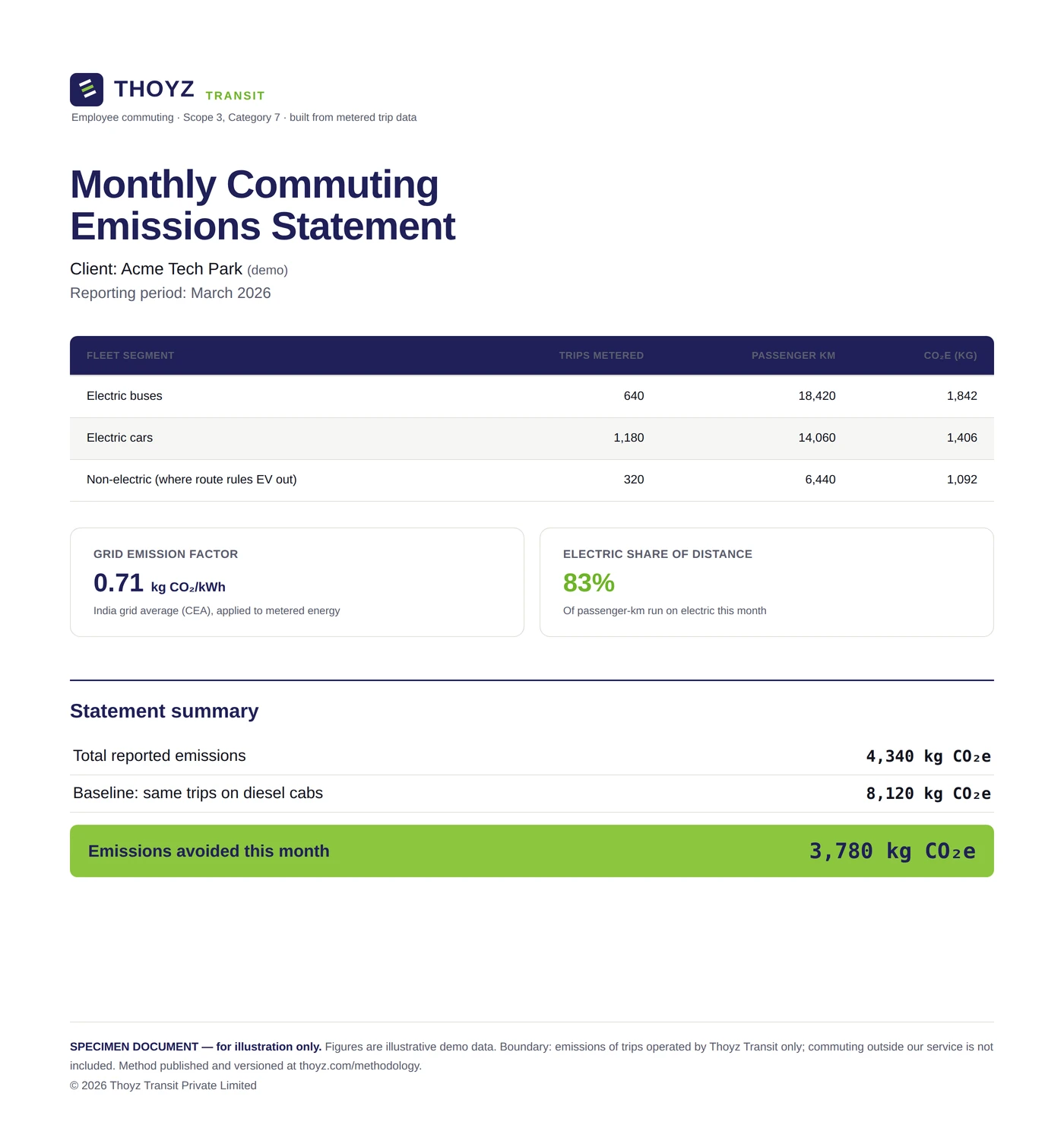
of trips metered, the figure is built from primary data, not a sample.
Scope 3 Category 7, mapped to the GHG Protocol.
the method is public, versioned and dated.
The data hierarchy
Why metered beats modelled.
The GHG Protocol sets out a data hierarchy: primary, measured data sits above modelled or averaged estimates. A number computed from trips that actually ran is higher up that hierarchy than a number grossed up from a survey.
That is the whole wedge. We are not claiming a better model. We are claiming better data, and better data is the thing an assurance process rewards.
Disclosure fit
How it drops into a BRSR or CDP disclosure.
An input, not a translation exercise.
The statement is structured to map onto the disclosures your team already files, the commuting line in a BRSR, the relevant Scope 3 category in a CDP response, so it is an input, not a translation exercise. The exact field mapping is confirmed with your reporting team against the disclosure format you file.
The boundary
What we cover, and what we don’t.
We report the emissions of the trips we operate. We do not silently absorb the commuting your people do outside our service, personal vehicles, other modes, trips we don’t run, into the figure and call it complete.
The boundary is stated on every statement, because a number is only trustworthy when its edges are drawn where you can see them. The boundary definition sits in the method →
Stated carefully
What the regulation actually requires.
Overstating the rules is the fastest way to lose the one buyer who knows them better than we do.
It is worth being precise here, because overstating the rules is the fastest way to lose the one buyer who knows them better than we do.
In India’s BRSR framework, employee-commuting emissions currently sit under the Leadership Indicators, the voluntary tier, rather than the mandatory core. BRSR Core assurance is being phased in for the largest listed companies on a comply-or-explain basis, expanding over time. So for most companies today, reporting commuting emissions is a choice, not a legal obligation.
The real pressure is rarely the letter of the regulation. It is investors, CDP questionnaires, and multinational parents pulled into CSRD-style expectations, all of whom increasingly want a defensible number rather than a blank or a guess.
We state the position as it stands, and we re-check it against the latest SEBI circulars each quarter rather than letting it drift.
Show the working
We publish the method.
The formula, the grid emission factor and its source, the ICE baseline, the boundary and the known limitations are all written out on a page of their own, because a number you cannot check is a number an assurance provider will not accept.
Questions people ask
Straight answers, before the call.
Is reporting commuting emissions mandatory in India?
For most companies today, no. It sits under BRSR Leadership Indicators, the voluntary tier. The pressure to report it well comes mainly from investors, CDP and global parent requirements. We’d rather you heard that from us than overclaim it.
How is your number different from a survey estimate?
It’s built from metered trips that actually ran, which sits above modelled or surveyed data in the GHG Protocol hierarchy, the distinction an assurance provider cares about.
Can I put this straight into our BRSR or CDP?
It’s structured to map onto those disclosures as an input. The exact field mapping is confirmed with your reporting team.
What about commuting you don’t operate?
We don’t include it. We report the trips we run and state the boundary on every statement, rather than presenting a partial figure as a total.
Can we see the method?
Yes. It’s published in full, versioned and dated.
Give your sustainability team a number they can defend.
Because we operate the trips, we report the number from primary data and publish the method, so a sustainability lead can trust it without having to call us.
Talk to us ↗